Toronto, Canada — 19th April 2026
Try Today: https://pktron.thecetqap.com/
In a major development for global quantum education and simulation technology, Pakistan’s rising quantum platform PKTron has officially revealed its latest next-generation simulator interface, showcasing a level of sophistication rarely seen in browser-based quantum systems.
The newly released simulator demonstrates that cutting-edge quantum tools are no longer limited to Silicon Valley labs or billion-dollar corporations. With PKTron’s latest innovation, advanced quantum circuit design, live simulation, visualization, and educational access are now available directly through a sleek browser environment.
A Quantum Lab Inside the Browser
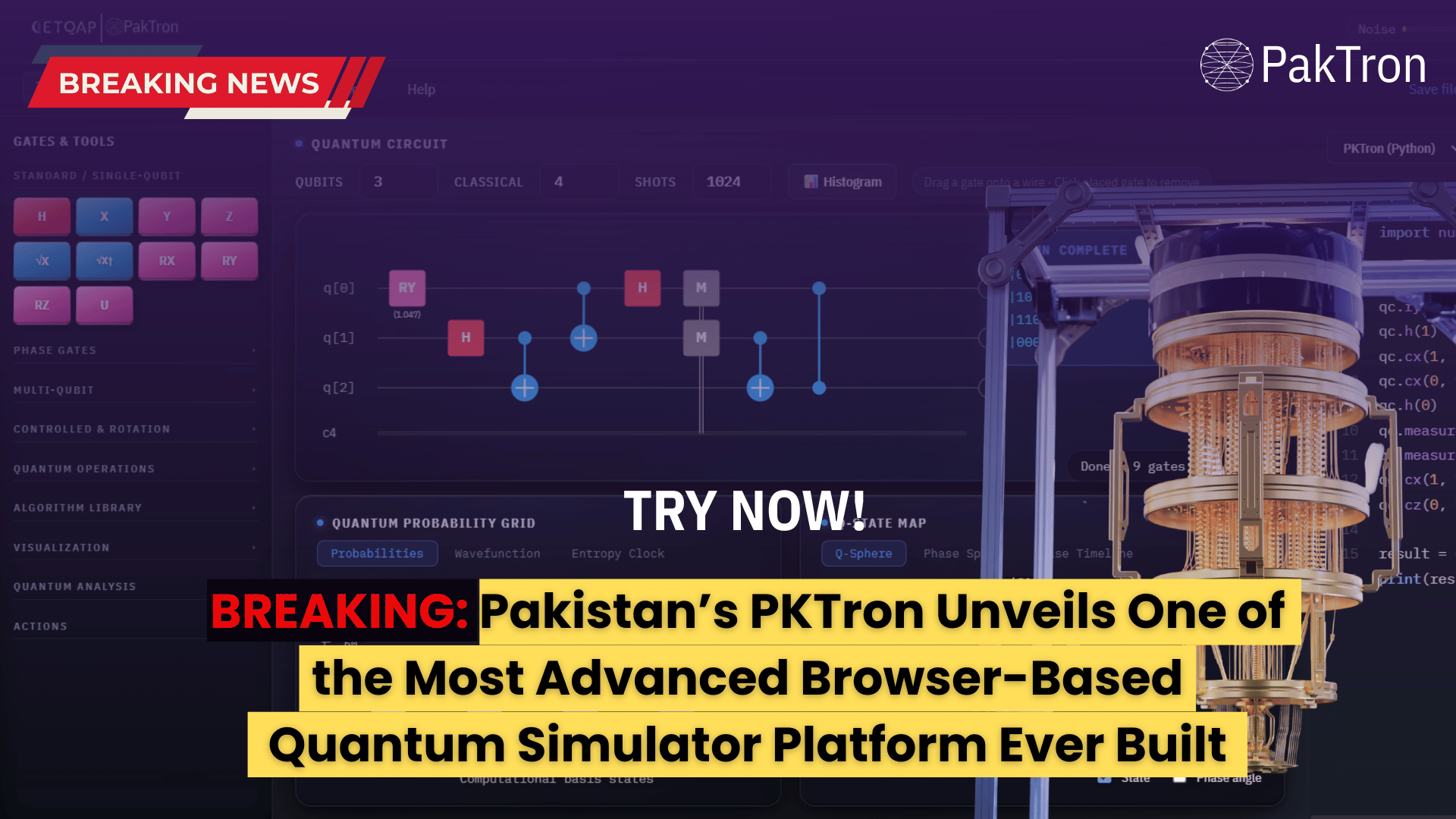
According to the released interface files, the simulator includes a professional-grade architecture featuring:
- Live quantum circuit builder with drag-and-drop gates
- Real-time probability grid
- Interactive Q-Sphere state mapping
- OpenQASM 2.0 and 3.0 export support
- Statevector simulation engine
- Entanglement analytics
- Bell inequality testing tools
- Quantum random number generator
- VQE energy simulation for H₂ molecule
- Bloch vector analysis
- Density matrix visualization
- Circuit replay system
- Algorithm library including Bell, GHZ, Grover, QFT, Teleportation and QAOA examples
Experts note that many standalone quantum learning platforms do not combine this many features in a single browser interface.
Pakistan Enters the Quantum Spotlight
The significance goes beyond software.
PKTron represents a growing shift in global technology leadership, proving that countries outside traditional tech power centers can build world-class quantum ecosystems. While most quantum headlines focus on the US, Europe, or China, PKTron signals that South Asia is now entering the quantum race with force.
This development may inspire universities, schools, startups, and governments across emerging markets to invest in homegrown quantum education systems.
Designed for the Next Generation
One of PKTron’s strongest advantages is accessibility. Instead of requiring expensive hardware or complicated cloud subscriptions, the platform appears focused on students, educators, and researchers who need immediate hands-on learning.
That means a teenager in Karachi, Lahore, Islamabad, or rural Pakistan could potentially explore quantum mechanics visually from a normal computer.
Why This Matters Globally
Quantum computing is expected to transform:
- Drug discovery
- Cybersecurity
- Materials science
- AI acceleration
- Financial modeling
- Logistics optimization
Nations building quantum talent today may lead tomorrow’s economy.
PKTron’s release suggests Pakistan is preparing early.
This is more than a simulator. It is a statement.
PKTron is showing that innovation can come from anywhere, and the future of quantum technology may not belong only to the biggest nations.
Pakistan has entered the quantum conversation, and the world should pay attention.