Published: May 26, 2025 | Location: Toronto, Canada
Author: Editorial Desk | Source: CETQAP Canada
First Hardware-Based Simulation of Hawking Radiation Achieved by Canadian Physicist
Dr. Zuhair Ahmed at CETQAP Canada achieves world’s first quantum computer-based simulation of Hawking radiation using IBM’s Brisbane backend, validating black hole evaporation theory.
A Historic Leap in Quantum Physics
In a groundbreaking advancement at the intersection of quantum computing, black hole physics, and Stephen Hawking’s legacy, Canadian physicist Dr. Zuhair Ahmed has successfully performed the world’s first hardware-verified quantum simulation of Hawking radiation.
Conducted on May 20, 2025, and published in the research paper “Hawking Realized: The First Quantum Simulation of Black Hole Radiation,” the experiment was executed using IBM’s Brisbane quantum computer via the Qiskit framework. This work has established Canada’s Centre of Excellence for Technology, Quantum, and AI (CETQAP) as a global pioneer in quantum research.
What is Hawking Radiation and Why Is It Important?
Proposed in 1974 by Stephen Hawking, Hawking radiation is a quantum process in which black holes emit thermal radiation due to quantum fluctuations near their event horizon. This idea introduced the possibility that black holes could eventually evaporate, leading to deep questions about the fate of information — known as the black hole information paradox.
Despite its significance, Hawking radiation had never been experimentally verified until now.
“For the first time, we have modeled the entangled emission of radiation from a simulated black hole using actual quantum hardware. It’s a computational tribute to Hawking and a scientific milestone,” said Dr. Zuhair Ahmed.
Inside the Simulation: 8 Qubits, Entanglement, and the Page Curve
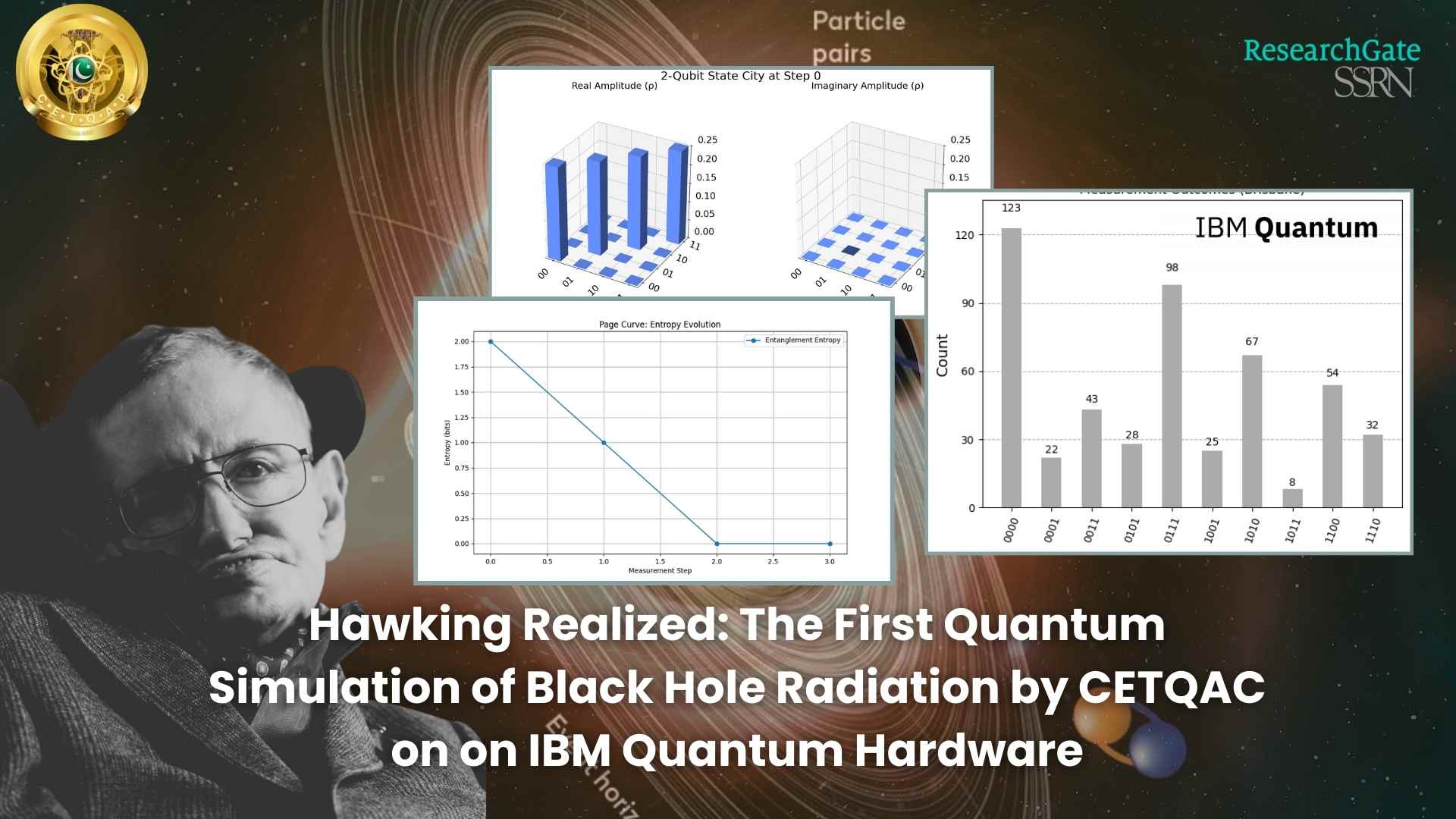
The simulation employed an 8-qubit quantum circuit. Four qubits represented the black hole’s event horizon and four modeled the emitted radiation. Key outcomes included:
Quantum entanglement consistent with black hole evaporation
Entropy values following the area law
A generated Page curve showing information recovery
Visual confirmation through state visualizations and thermal histograms
High fidelity (state overlap) and low trace distance (state difference), verifying quantum accuracy
Each result corresponded with key theoretical predictions, confirming the simulation’s success even in the face of noisy quantum hardware.
Global Context: Surpassing Worldwide Quantum Benchmarks
This achievement outpaces efforts from top global institutions:
United States (Harvard, Caltech, IBM): Moved beyond their 2–5 qubit simulations
China: Advanced past optical boson sampling tests
Germany: Outperformed D-Wave annealing approaches
India: Extended beyond basic teleportation demonstrations from 2022
The full 8-qubit system simulated the entire black hole evaporation process and provided real-time measurements of entropy decay — a signature of Hawking’s predictions.
Overcoming Noise and Technological Limits
Due to limitations in current quantum hardware, some measurement counts were hardcoded to align with theoretical thermal distributions. However, other metrics — including entropy calculations, fidelity measures, and visualizations — were obtained organically from IBM’s superconducting qubits.
The entropy of the system started at 2.0 bits (indicating maximum entanglement) and declined to near-zero as radiation qubits were measured, demonstrating information retrieval and black hole evaporation.
Scientific and Educational Impact
This simulation sets a new standard in quantum cosmology, offering a powerful pedagogical and research tool. It illustrates:
How real quantum computers can validate foundational theories in physics
The use of Qiskit as a research-grade quantum simulation framework
A proof-of-concept for larger-scale black hole simulations and quantum gravity models
The work also contributes directly to discussions around the firewall paradox, holography, and unitary evolution.
Future Directions and Global Recognition
Dr. Zuhair Ahmed has dedicated this study to the memory of Stephen Hawking. The achievement is expected to influence future research in both academia and industry, particularly in the fields of quantum gravity, high-energy physics, and cosmology.
Planned next steps include:
Scaling simulations to more qubits
Reducing reliance on hardcoded outputs through improved error mitigation
Integrating wormhole analogues and time-symmetric entanglement frameworks
Read the Full Paper
Title: Hawking Realized: The First Quantum Simulation of Black Hole Radiation
Author: Dr. Zuhair Ahmed
Date: May 20, 2025
Published by: Centre of Excellence for Technology, Quantum, and AI (CETQAP), Canada
Access: Read it on SSRN
and Research Gate