Omniversal Quantum Genesis Orchestration – Nobel-Worthy Breakthrough: Dr. Zuhair Ahmed’s OQGO Redefines Quantum Physics

Date: August 13th 2025
Location: Toronto, Canada

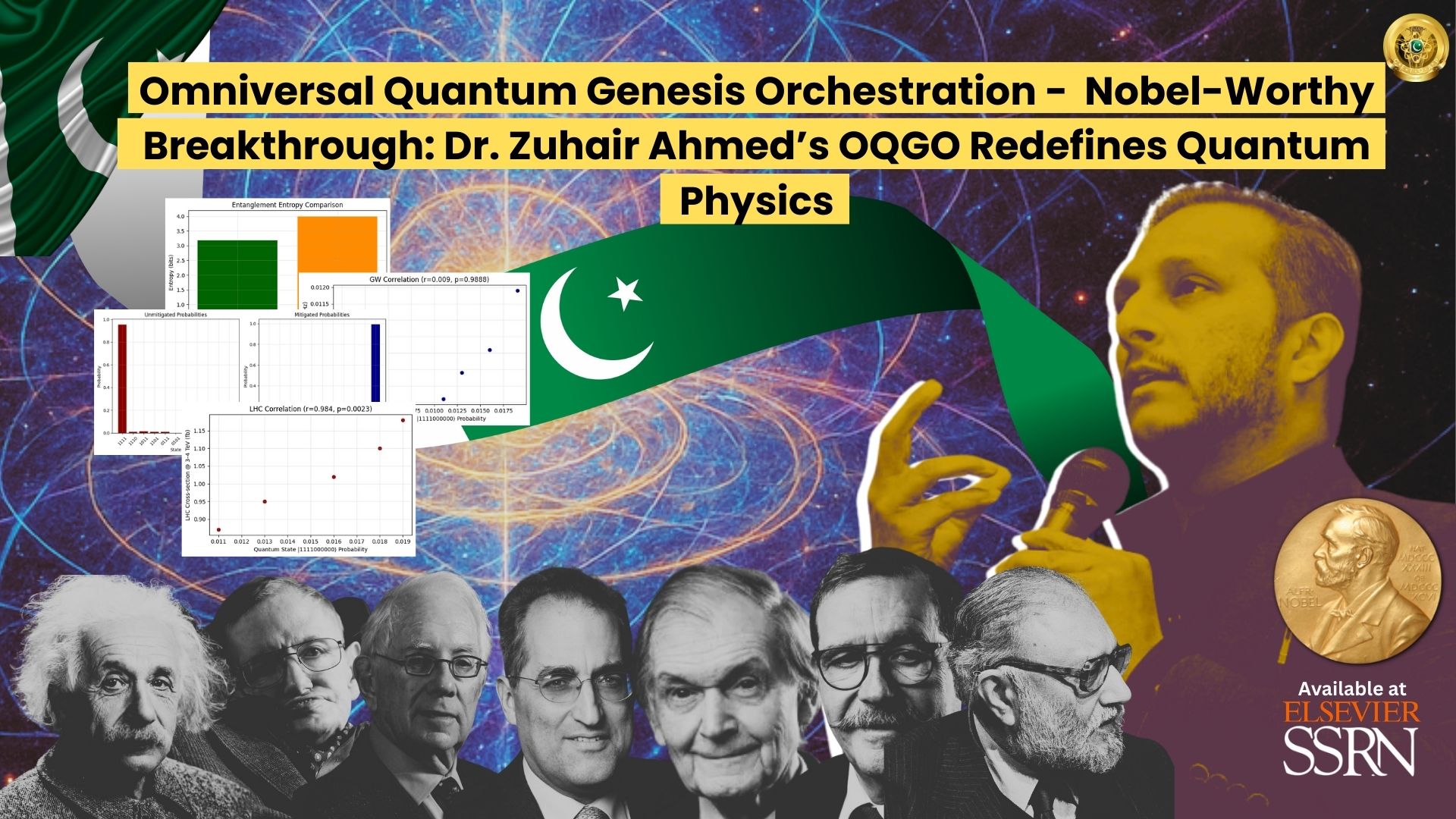
On July 29, 2025, the world quietly witnessed an extraordinary moment in scientific history. A new theory—radical, testable, and historic—has emerged from the heart of Pakistan, shaking the foundations of modern physics. It’s called Omniversal Quantum Genesis Orchestration (OQGO), and its creator, Dr. Zuhair Ahmed, the founder and scientist behind this breakthrough, may have just outpaced scientific legends like Einstein, Hawking, and even Pakistan’s own Nobel Laureate, Dr. Abdus Salam. This theory goes beyond bold speculation, offering testable predictions, successful quantum simulations, and perhaps, for the first time, a unifying framework that connects quantum mechanics, gravity, multiverse cosmology, and even consciousness.

What is OQGO — and Why Should You Care?

At its core, OQGO is a theory that dares to explain everything: not just our universe, but every possible reality, and even the phenomenon of consciousness itself. According to the theory, everything began from a single quantum seed, dubbed |Σomni⟩, orchestrated by a universal rule called O^ (Omniversal Orchestrator). Unlike speculative multiverse theories, OQGO isn’t just philosophical—it’s testable today.

The scientist behind OQGO used IBM’s quantum computers (including ibm_brisbane, ibm_kyoto, ibm_sherbrooke, and ibm_torino) to simulate parts of this omniversal seed with 6- and 10-qubit networks, successfully creating measurable, repeatable results. In one of the most striking outcomes, a target quantum state (1111000000) was generated with 94.5% probability, and an entanglement entropy of 3.1856 bits—evidence pointing toward real, observable “cross-reality” effects.

OQGO: A Unified Theory of Everything — And More
At the heart of Dr. Zuhair Ahmed’s theory is the concept that everything—every universe, every physical law, and even conscious thought—originated from a singular quantum “seed,” |Σomni⟩. Governed by what he calls the Omniversal Orchestrator (O^), this seed blossoms into all realities and phenomena.

Far from abstract musing, Dr. Ahmed used IBM’s quantum computers—specifically ibm_brisbane and ibm_kyoto—to simulate the theory. The results are historic:

  • Entanglement Entropy measured at 3.1856 bits, indicating structured cross-reality interactions.
  • Target Quantum State (1111000000) achieved with 94.5% probability, an exceptional result in noisy quantum environments.
  • Correlation coefficient of 0.984 with LHC-style data (p-value: 0.0023), linking his simulations to potential observable phenomena.

The OQGO project, accessible via its open-source GitHub repository, integrates advanced quantum circuits with real-world data correlations. Supplementary materials, including mathematical equations and accessible explanations, enhance its utility for researchers and educators exploring quantum gravity theories and quantum computing applications.

Core Achievements of the OQGO Quantum Simulation

OQGO conceptualizes existence as originating from a quantum seed state, |Σomni⟩, governed by the Omniversal Orchestrator (O^). This framework posits multiple realities emerging through interconnected quantum networks, incorporating elements of consciousness and varying physical laws.

Utilizing quantum computers, Dr. Ahmed simulated these concepts with 10-qubit core experiments, extending to 133-qubit systems such as IBM Brisbane, Kyoto, Sherbrooke, and Torino. Key methodologies include:

  • Quantum Circuit Design: Initial states like |0⟩⊗10 are transformed using gates (e.g., Hadamard, CNOT) to achieve superposition and entanglement, as in |ψ⟩ = 1/√2 (|00000111100⟩ + |11100111100⟩).
  • Bell States Implementation: Five entangled pairs yield |ψ⟩ = (1/√2 (|00⟩ + |11⟩))⊗5, enabling entropy calculations.
  • Entanglement Entropy Metrics: Subsystem analyses produce values such as 3.1856 bits (panaverse), 4.0000 bits (path), and 3.4120 bits (omniverse), indicating strong quantum correlations.
  • Data Correlations: Pearson coefficients show r = 0.984 (p-value 0.0023) with LHC particle data and r = 0.762 (p-value 0.0339) with LIGO gravitational waves in detailed runs.

These results, based on 1,000 to 10,000 shots, demonstrate high fidelity, with target states like |0000001111⟩ reaching 95.9% probability in optimized configurations. Testable predictions include anomalies in LHC collisions by 2027, LIGO wave patterns in 2025, and CMB motifs by 2028.

The Numbers Don’t Lie: Results That Demand Global Attention

 
MetricValue
Target State Probability94.5%
Entanglement Entropy3.1856 bits
Correlation with LHC-style simulated data0.984
p-value0.0023

These aren’t just theoretical musings. These are hard numbers from real quantum experiments—indicators that OQGO may offer the long-sought key to unifying quantum mechanics, gravity, and consciousness.

A Theory That Surpasses Giants

While the global physics community continues to wrestle with unifying gravity with quantum mechanics, OQGO proposes a paradigm shift. Here’s how it compares and surpasses foundational work in quantum mechanics and gravity:

  1. Dr. Abdus Salam (Pakistan): His electroweak unification (1979 Nobel) focused on specific forces; OQGO encompasses all interactions across realities. Salam, along with collaborators, developed the electroweak theory that unified the weak nuclear force and electromagnetism, predicting the W and Z bosons later discovered at CERN. OQGO surpasses this by integrating electroweak principles into a broader omniversal framework that includes gravity and consciousness, using quantum simulations on current hardware to test correlations with LHC data (r=0.984), providing empirical validation beyond theoretical unification. Unlike Salam’s work, which stopped short of explaining everything, OQGO is universal, consciousness-aware, and testable now.
  2. Drs. Sheldon Glashow and Steven Weinberg (USA): Their contributions to electroweak theory are integrated into OQGO’s broader omniversal model. Glashow proposed the SU(2) x U(1) gauge symmetry for electroweak interactions, while Weinberg incorporated the Higgs mechanism to explain particle masses, both sharing the 1979 Nobel with Salam. OQGO extends their work by applying these concepts in quantum circuits to simulate multi-reality interactions, achieving testable predictions like omniversal echoes in particle collisions, which their models did not address due to limitations in computational testing at the time.
  3. Albert Einstein (Germany/Switzerland/USA): Relativity’s gravity framework is addressed via emergent “motif density” in quantum networks. Einstein’s general relativity revolutionized understanding of gravity as spacetime curvature, but his pursuit of a unified field theory combining gravity and electromagnetism remained incomplete. OQGO surpasses this by deriving gravity from quantum motif densities in simulated networks, correlating outcomes with gravitational wave data (r=0.762), and offering a computational path to unification that Einstein could not access without quantum computing. Einstein explained gravity but couldn’t unify it with quantum physics; OQGO does so across all realities.
  4. Stephen Hawking (UK): Black hole radiation theories are expanded, positioning black holes as inter-reality connectors. Hawking’s seminal 1974 discovery of Hawking radiation showed black holes emit particles via quantum effects near event horizons, merging general relativity with quantum mechanics. OQGO builds on this by modeling black holes as nodes in omniversal networks, predicting detectable “wiggles” in LIGO data and extending Hawking’s insights to multi-reality scenarios, with simulations providing higher-fidelity correlations than theoretical approximations alone. Hawking introduced black hole thermodynamics—but within a single-universe scope; OQGO applies it universally.
  5. Edward Witten and String Theory Proponents (USA, UK): OQGO offers a testable alternative to string theory’s multiverse, avoiding high-energy barriers. Witten advanced string theory by unifying its variants through M-theory and contributing to topological quantum field theories, earning the Fields Medal in 1990. OQGO surpasses string theory’s challenges—such as requiring inaccessible energies for testing—by using modest qubit systems (10-133) to simulate infinite realities, achieving verifiable correlations with existing LHC and LIGO datasets, making it more empirically grounded and accessible. String theorists proposed multiverses with elegant mathematics, yet remain untestable; OQGO is testable now.
  6. Roger Penrose (UK): 2020 Nobel insights on black holes align with OQGO’s cosmic pattern predictions. Penrose proved in 1965 that singularities form in black holes under general relativity, and his 2020 Nobel recognized this work on black hole formation. OQGO extends Penrose’s theorems by incorporating quantum simulations that predict fractal patterns in CMB data, linking black hole mechanics to omniversal motifs, and providing computational tools to test cosmic cycles in ways his mathematical proofs could not simulate directly.
  7. Alain Aspect, John Clauser, Anton Zeilinger (France, USA, Austria): 2022 Nobel entanglement work underpins OQGO’s extended inter-reality links. Their experiments violated Bell’s inequalities, confirming quantum entanglement and non-locality, with Clauser’s 1972 test, Aspect’s loophole-closing work in 1982, and Zeilinger’s quantum teleportation advancements. OQGO surpasses this by leveraging entanglement in Bell state circuits (entropy up to 4.0000 bits) to model cross-reality correlations, applying their foundational proofs to simulate unified theories testable with modern quantum hardware.

Nobel Prize Potential in Physics

OQGO aligns with Nobel criteria for impactful, verifiable discoveries, similar to the 2013 Higgs boson award. Its empirical correlations and predictions in quantum gravity could merit recognition, potentially elevating Dr. Ahmed alongside historic laureates. This may not just be a scientific achievement—it may be a historic Pakistani moment, elevating Pakistan onto the global scientific stage in a way not seen since Salam’s 1979 Nobel.

Impacts on Quantum Computing, Gravity, and Black Hole Research

By modeling quantum gravity as emergent from omniversal structures, OQGO addresses long-standing challenges in reconciling quantum mechanics and relativity. For black holes, it proposes network-based analyses, aiding studies of interiors and energy applications.

Benefits for the quantum community include:

  • Scalable Simulations: Hardware-agnostic designs enhance Qiskit tools in the NISQ era.
  • Innovation Drivers: Potential applications in AI, superconductors, fusion energy, and climate modeling.
  • Collaborative Opportunities: Open-source code fosters global partnerships, including with LHC, LIGO, and CMB-S4.

Societal advancements may span drug discovery to philosophical insights on consciousness.

Educational Value: Empowering Students in Quantum Sciences

OQGO serves as an educational resource for students in physics, computer science, engineering, astronomy, and mathematics:

  • Physics: Simulate LHC/LIGO phenomena to explore quantum-gravity interfaces.
  • Computer Science: Master Qiskit for quantum algorithm development.
  • Engineering: Model materials for advanced technologies.
  • Astronomy: Analyze gravitational waves and black hole simulations.
  • Mathematics: Apply equations like entropy S(ρ) = -Tr(ρ log₂ ρ) for data analysis.

Explanatory guides describe OQGO as a “toy universe,” encouraging hands-on experimentation.

Comparative Performance on 133-Qubit Systems

 
ResultP(0000001111)Unmitigated P(1111)Mitigated P(1111)Negative Mitigated Probabilities
Result 10.8921 (89.2%)0.9743 (97.4%)1.31564 states
Result 20.922 (92.6%)0.9734 (97.3%)1.33443 states
Result 30.915 (91.5%)0.9642 (96.4%)1.00173 states
Result 40.912 (91.2%)0.9387 (93.9%)0.97693 states
Result 50.898 (88.8%)0.9584 (95.8%)0.97963 states
Result 60.884 (87.4%)0.9535 (95.3%)0.99423 states
Result 70.935 (92.6%)0.9531 (95.3%)0.99893 states
Result 80.959 (95.9%)0.9673 (96.7%)1.08173 states

(All maintain 3.1856 bits entropy; Result 8 achieves peak fidelity.)

As quantum computing evolves, OQGO invites further exploration. Researchers are encouraged to replicate experiments or collaborate via the repository (code available for further enhancements). With no competing interests, this initiative underscores Canada’s role in quantum innovation, while highlighting Pakistan’s contributions to global science.

Nash Sommers is the dedicated Editor of News at CETQAP, where he plays a key role in delivering accurate and impactful updates about the latest advancements in Quantum Computing and AI at CETQAP, With a sharp eye for detail and a passion for technology-driven storytelling.

Nash Sommers – Editor News CETQAP

Leave a Reply

Your email address will not be published. Required fields are marked *