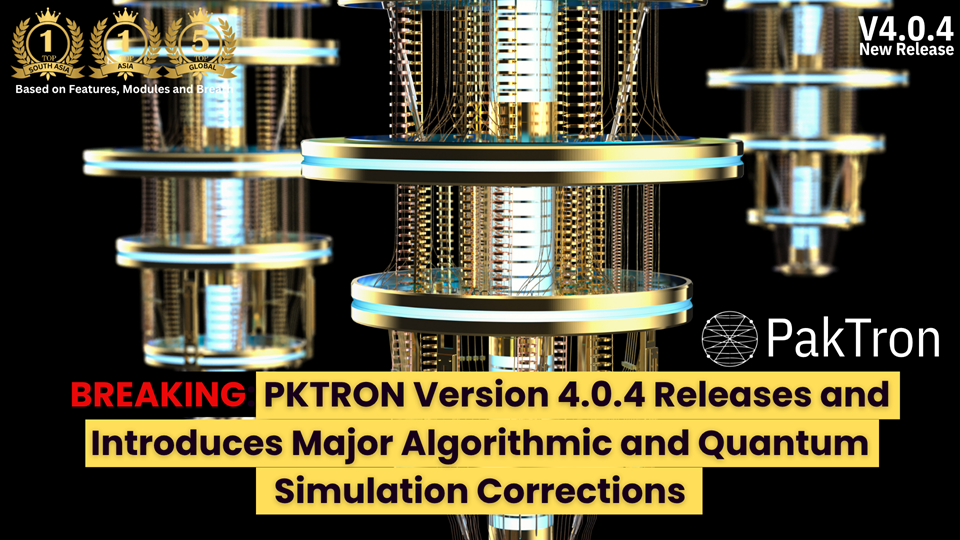
The development team behind PKTRON has officially released Version 4.0.4, a significant update focused on algorithmic correctness, quantum chemistry accuracy, variational optimization stability, and quantum error-correction consistency.
The release introduces nine major correctness fixes affecting several foundational quantum computing algorithms and simulation modules. The update targets previously identified issues in oracle construction, phase estimation, variational eigensolvers, adaptive ansatz generation, logical error-rate modeling, and hidden-period recovery systems.
One of the primary corrections involves the Deutsch-Jozsa algorithm implementation. Earlier versions incorrectly classified constant oracles as balanced due to improper ancilla handling. Version 4.0.4 resolves this issue through a corrected ancilla X-gate application, producing a validated all-zero probability of 1.0 for constant functions.
The Quantum Phase Estimation module also received a substantial reconstruction. Previous implementations returned zero-valued estimates independent of the encoded phase. The updated release corrects the controlled-unitary evolution chain and inverse Quantum Fourier Transform pipeline, enabling accurate phase reconstruction. Validation tests for θ = 0.3 produced an estimated value of 0.30078125.
The Grover Search implementation has been redesigned for improved scalability and correctness at higher qubit counts. Earlier versions exhibited instability for systems with four or more qubits. The updated architecture introduces a diagonal-matrix oracle together with a corrected diffusion operator, achieving a measured success probability of 0.9453 during 4-qubit validation experiments.
Quantum chemistry simulation modules received several physics-oriented corrections. The H₂ Hamiltonian generator now uses an exact Pauli decomposition aligned with STO-3G reference values, replacing earlier heuristic scaling approaches that altered eigenvalue spectra. Validation results produced the following Hamiltonian diagonal:
[-1.8572, -0.2432, -0.2432, 0.2252]
The Variational Quantum Eigensolver (VQE) module was also upgraded with a hardware-efficient ansatz, BFGS optimization, and parameter-shift gradient evaluation. The updated solver converged to an energy of -1.872798 Hartree, matching Full Configuration Interaction (FCI) reference energy values.
Additional improvements extend to the UCCSD and ADAPT-VQE solvers. The UCCSDSolver now correctly extracts Hartree-Fock reference energies using minimum diagonal evaluation, while also introducing a hardware-efficient fallback for zero-electron configurations. The ADAPTVQESolver was corrected through the implementation of a proper skew-Hermitian operator pool and energy-scan gradient evaluation, enabling monotonic convergence across adaptive layers.
Quantum error-correction functionality also received analytical corrections. The SurfaceCodeDistance module now generates strictly monotonic logical error-rate reduction as code distance increases, aligning simulation behavior with theoretical expectations for fault-tolerant quantum error correction. Validation measurements showed decreasing logical error probabilities across distances d=3, d=5, and d=7.
The release additionally resolves a major limitation in Simon’s Algorithm. Earlier implementations lacked proper GF(2) post-processing recovery from sampled measurements. Version 4.0.4 introduces a dedicated _solve_gf2() recovery system capable of reconstructing hidden periods directly from quantum measurement outputs.
Validation Summary
- DeutschJozsa constant oracle → all_zero_prob = 1.0000
- QuantumPhaseEstimation θ=0.3 → estimated = 0.30078125
- GroverSearch 4-qubit [5,10] → success_prob = 0.9453
- H₂ Hamiltonian → STO-3G aligned eigenvalues verified
- VQE → energy = -1.872798 Ha (FCI matched)
- UCCSDSolver → error below 1e-9 Hartree
- ADAPTVQESolver → monotonic convergence across adaptive layers
- SurfaceCodeDistance → logical error rate decreases with increasing distance
- SimonsAlgorithm → hidden period successfully reconstructed
Version 4.0.4 represents a substantial stabilization and scientific-correctness update for PKTRON, particularly in the areas of quantum algorithm simulation, variational quantum chemistry, adaptive eigensolver architectures, and quantum error-correction modeling. The release strengthens the framework’s consistency across both educational and research-oriented quantum simulation workflows.