The quantum computing ecosystem has a major new release.
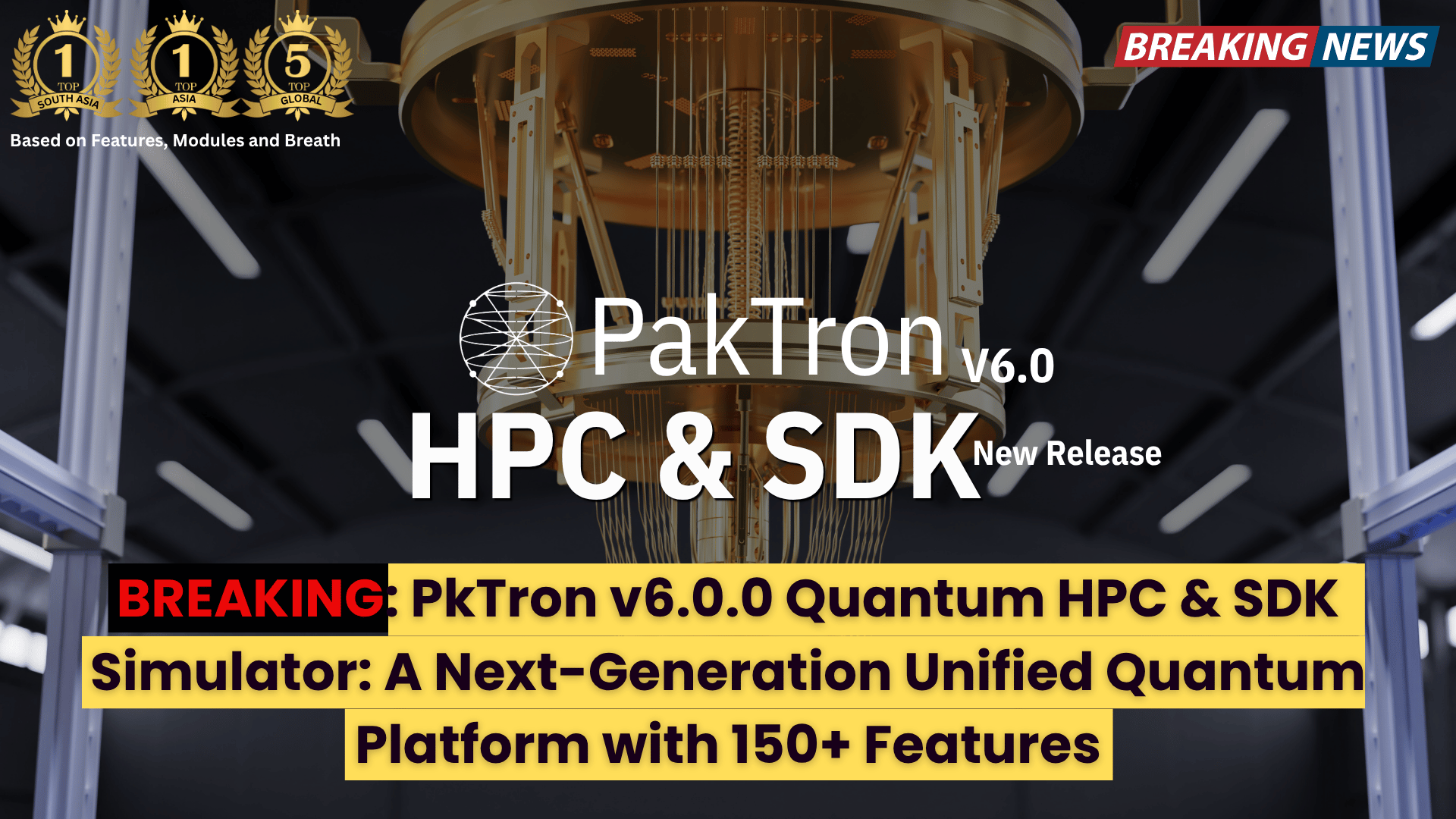
PkTron v6.0.0 Quantum HPC & SDK Simulator, developed by CETQAC (Centre of Excellence for Technology Quantum and AI Canada/Pakistan), has officially launched as one of the most feature-dense open-source quantum computing platforms available today.
With 10,000+ PyPI downloads, MIT licensing, Python ≥3.8 support, and a tightly integrated HPC + SDK architecture, the framework is designed to unify simulation, quantum development tools, and high-performance execution in a single environment.
A simple install:
pip install pktronunlocks a complete ecosystem spanning quantum simulation, machine learning, cryptography, chemistry, finance, defense systems, and distributed computing.
A Unified Quantum HPC + SDK Platform
PkTron v6.0.0 is built as a Quantum HPC + SDK Simulator, combining both development tools and execution infrastructure.
It includes:
- 13 quantum simulator backends
- 50+ quantum algorithms
- 10+ quantum machine learning models
- 6 quantum error-correction codes
- 9+ error mitigation techniques
- Quantum cryptography suite (6 protocols)
- Finance and defense modules
- GPU + MPI distributed HPC runtime
- Tensor network computing (MPS, PEPS, MERA, DMRG)
- Full SDK interoperability layer
The framework ships with 150+ classes, 26 functions, and 39 submodules, making it one of the most comprehensive quantum SDK ecosystems in open source.
What’s New in v6.0.0?
1. New Pauli Algebra System
A major upgrade introduces pk.Pauli, a physics-accurate algebra system based on symplectic representation.
It supports:
- Operator composition
- Tensor products
- Commutation and anti-commutation
- Matrix representation
- Hermitian adjoint operations
It correctly reproduces core quantum identities such as:
- XY = iZ
- [X, X] = 0
- {X, Z} = 0
2. E91 Quantum Key Distribution Protocol
A new cryptographic feature adds entanglement-based QKD via E91Protocol.
Capabilities include:
- CHSH inequality validation
- Eavesdropping detection
- Entanglement-based secure key generation
Typical results:
- Clean channel: CHSH ≈ 2.77
- Eavesdropping detected when CHSH drops below classical bounds
This expands PkTron beyond BB84 into advanced quantum-secure communication models.
3. M3 Measurement Mitigation System
The new M3 mitigation engine improves scalability of noisy quantum measurements.
Key features:
- Matrix-free computation
- Subspace-based reconstruction
- Large-qubit scalability improvements
It targets one of the hardest problems in quantum hardware simulation: readout noise at scale.
4. Core Stability and Backend Improvements
- Fixed MPS SVD entanglement bug using standard linear algebra routines
- Improved tensor network reliability
- Simplified access to
SparsePauliOpat top level - Expanded DMRG integration across tensor networks
These updates improve correctness and consistency across multiple simulation layers.
Quantum Execution Examples
PkTron supports high-level execution with minimal code.
Bell State
qc = pk.QuantumCircuit(2)
qc.h(0); qc.cx(0, 1)
result = pk.StatevectorSimulator().run(qc, shots=1024)
print(result["counts"])
Grover Search
g = pk.GroverSearch(n_qubits=4, marked_states=[5, 10])
r = g.run()
print(r["success_prob"])
VQE on H₂
H = pk.QuantumChemistry.h2_hamiltonian(distance=0.735)
r = pk.VQE(H).run(ansatz_depth=2)
print(r["energy"])
Quantum Chemistry, AI, and Machine Learning
PkTron v6.0.0 integrates deep scientific modules:
Quantum Chemistry
- UCCSD and ADAPT-VQE
- Molecular Hamiltonians
- Jordan–Wigner and Bravyi–Kitaev mappings
- Multi-molecule support (H₂, N₂, CH₄, CO₂, NH₃, etc.)
Quantum Machine Learning
- QNN, QSVM, QGAN, QCNN
- Quantum reinforcement learning
- Federated quantum learning
- Kernel-based quantum classifiers
- Barren-plateau-resistant architectures
Finance and Defense Applications
PkTron extends beyond research into applied domains.
Finance Module
- Portfolio optimization
- Option pricing via QAE
- Risk modeling (VaR, ES)
- Quantum anomaly detection
Defense Module
- Mission scheduling
- Vehicle routing optimization
- Swarm intelligence models
- Quantum cryptanalysis tools
HPC Architecture
A major strength of PkTron is its native HPC acceleration layer.
CPU + C Kernels
- AVX-512 / AVX2 / SSE optimization
- OpenMP parallel execution
- Gate fusion and kernel optimization
GPU Acceleration
- CuPy-based backend
- CUDA kernels for quantum operations
Distributed Execution
- MPI-based distributed runtime
- Multi-GPU scheduling
- Task graph execution engine
This allows PkTron to scale from laptop simulations to HPC clusters.
Interoperability Layer (SDK Strength)
As a full Quantum SDK, PkTron integrates with:
- Qiskit
- Cirq
- PennyLane
- OpenQASM 2/3
- Quil
- IonQ
- Amazon Braket
This makes it suitable as both a standalone simulator and a cross-platform development layer.
Why PkTron Stands Out
| Capability | PkTron v6.0.0 |
|---|---|
| Simulator backends | 13 |
| Quantum algorithms | 50+ |
| QML models | 10+ |
| Error correction codes | 6 |
| QKD protocols | 6 |
| HPC acceleration | Yes |
| GPU + MPI support | Yes |
| Tensor networks | Full stack |
| Interoperability | 5+ ecosystems |
| License | MIT |
| Downloads | 10K+ |
The combination of SDK tooling + HPC execution + quantum breadth makes it one of the most integrated quantum frameworks currently available in open source.
Final Outlook
PkTron v6.0.0 represents a shift toward unified quantum software ecosystems, where simulation, machine learning, cryptography, and high-performance execution are no longer separate tools but part of a single SDK-driven platform.
With its expanding architecture, PkTron positions itself as a full-stack quantum computing environment designed for research, education, and industry-scale experimentation.
MIT Licensed. HPC Ready. SDK Powered. Quantum Unified.