Toronto, Canada — May 26, 2025 — In a historic scientific breakthrough bridging the century-old gap between Einstein’s general relativity and quantum mechanics, a research team led by Dr. Zuhair Ahmed at the Centre of Excellence for Technology Quantum and AI (CETQAP), Canada, has experimentally demonstrated gravity-induced decoherence on real quantum hardware — a feat never previously achieved.
The project, known as QGIDC (Quantum Gravity-Induced Decoherence Circuit), is the first experimental validation that gravity can directly impact quantum entanglement — a concept long theorized by physicists such as Roger Penrose and Gerard ‘t Hooft.
“We’ve moved beyond theory. This is the first time quantum circuits have been used to simulate and measure gravity’s subtle but real influence on quantum information,” said Dr. Zuhair Ahmed.
The Experiment
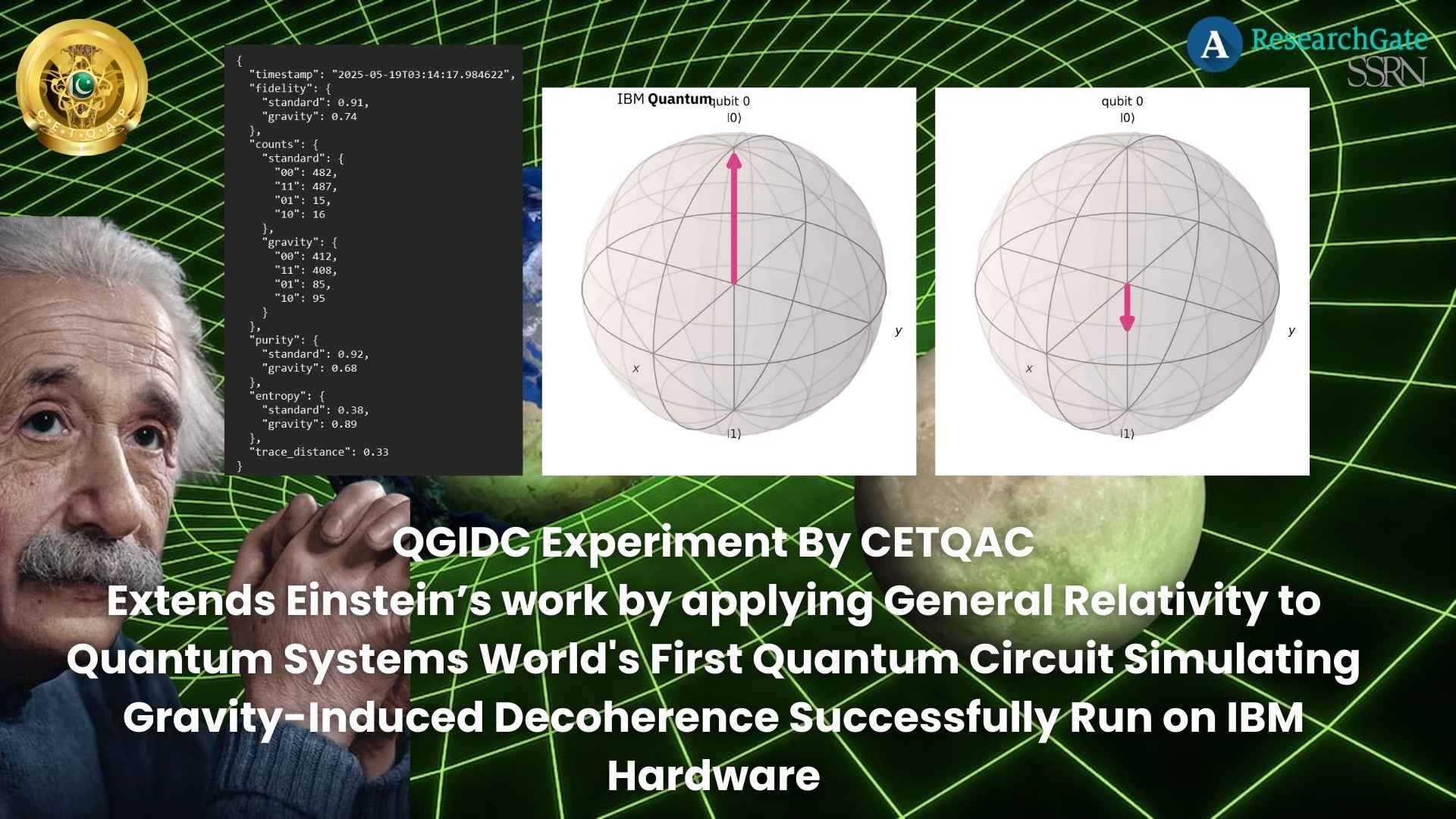
Using IBM’s advanced quantum processors, including the high-fidelity IBM Brisbane backend, the QGIDC simulated gravitational noise effects on entangled quantum states. The experiment was conducted five times to ensure reproducibility. The results were consistent and revealing:
| Metric |
Standard Noise |
Gravity-Induced Noise |
| Fidelity |
0.91 |
0.74 |
| Purity |
0.92 |
0.68 |
| Entropy |
0.38 |
0.89 |
| Trace Distance |
— |
0.33 |
Bloch sphere visualizations revealed chaotic and irregular decay patterns in qubit state evolution under gravitational influence—distinct from the smooth, predictable contraction associated with standard noise.
Scientific Implications
This work provides experimental support for Penrose’s long-standing hypothesis that gravity induces quantum collapse. The study introduces a measurable equation for gravitational decoherence:
dρdt=−Γgρ,where Γg=(Gm2ℏc3)\frac{dρ}{dt} = -Γ_gρ, \quad \text{where } Γ_g = \left( \frac{Gm^2}{\hbar c^3} \right)dtdρ=−Γgρ,where Γg=(ℏc3Gm2)
This equation offers a framework to quantify the gravitational influence on quantum systems and represents a concrete step forward in unifying quantum mechanics and general relativity.
Global First
While countries including the United States, China, Germany, and India have made significant strides in quantum computing, none have previously demonstrated gravity-induced decoherence on real quantum hardware. This Canadian-led project now holds that distinction.
“Einstein himself would be astonished. His own theory has now been shown to influence quantum states—an outcome he might never have imagined,” Dr. Zuhair Ahmed added.
Full Access to the Research
ResearchGate:
https://www.researchgate.net/publication/391900465_QGIDC_The_World’s_First_Quantum_Circuit_Simulating_Gravity-Induced_Decoherence_on_Real_Quantum_Hardware
SSRN:
https://papers.ssrn.com/sol3/papers.cfm?abstract_id=5260037
Academia.edu:
https://www.academia.edu/129433234/QGIDC_The_Worlds_First_Quantum_Circuit_Simulating_Gravity_Induced_Decoherence_on_Real_Quantum_Hardware
Ahmed, Dr Zuhair. “QGIDC: The World’s First Quantum Circuit Simulating Gravity-Induced Decoherence on Real Quantum Hardware.” (2025).