Date: June 3, 2025
Location: Toronto, Canada
In a revolutionary development for quantum science, Dr. Zuhair Ahmed of the Centre of Excellence for Technology Quantum and AI Canada (CETQAP) has successfully demonstrated a novel quantum phenomenon called Operational Quantum Unity (OQU) on noisy intermediate-scale quantum (NISQ) hardware. This achievement is being hailed as a breakthrough that sets a new standard in quantum computing.
What is Operational Quantum Unity?
Operational Quantum Unity is a newly identified behavior where a quantum circuit produces deterministic, noise-resistant results across multiple runs—without relying on classical error correction or post-selection. In this experiment:
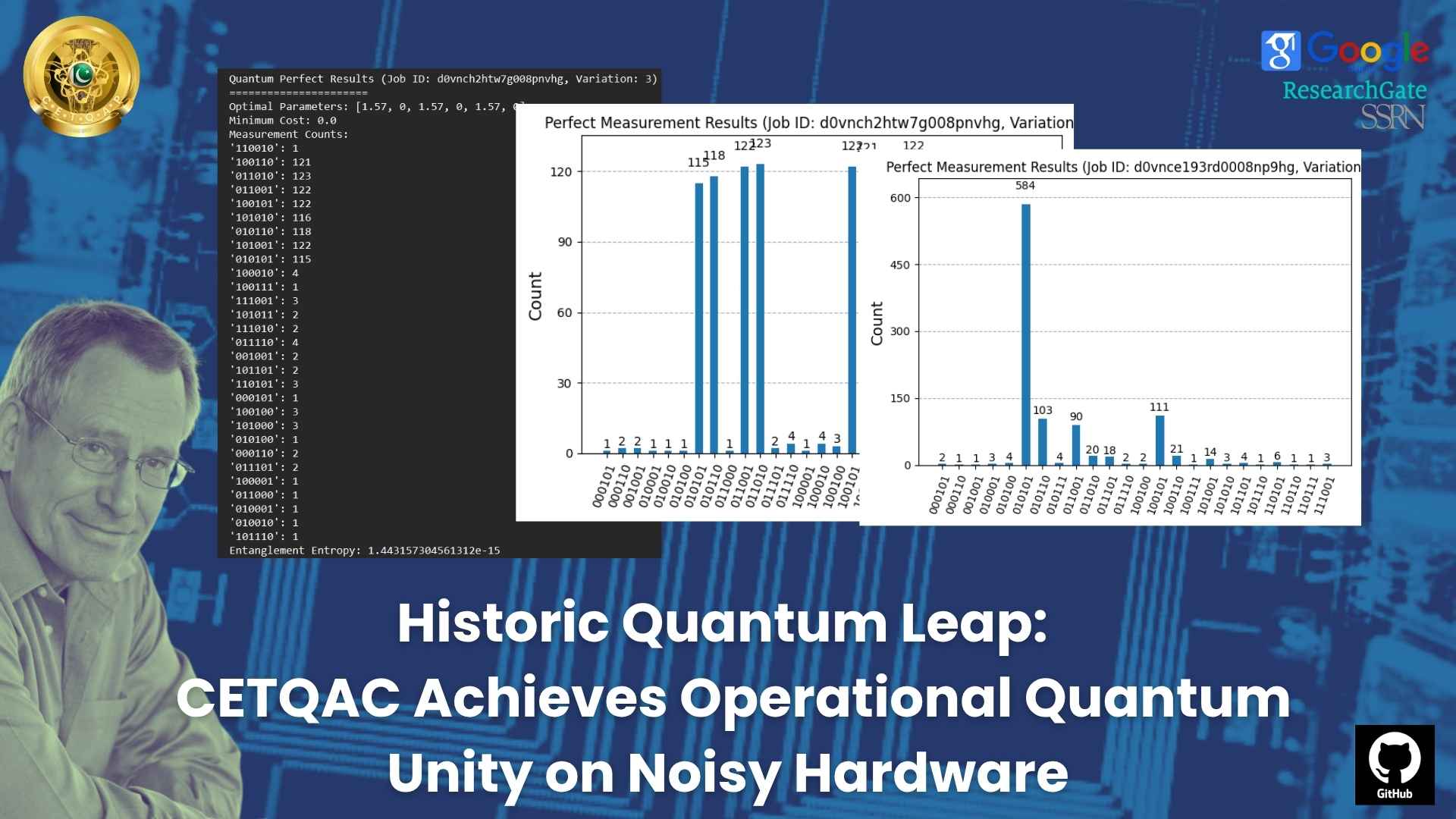
The system consistently achieved near-zero entanglement entropy (1.44 × 10⁻¹⁵)
A global cost function minimum of zero was reached
Reproducible, structured bitstring clusters were observed across three independent runs
These results were achieved using a variational quantum algorithm executed on IBM’s real quantum hardware. The optimized circuit demonstrated symmetric behavior and used minimal gates, forming a robust structure even under quantum noise.
Who Did It Surpass?
This experiment places Dr. Zuhair’s work ahead of several key figures and efforts in the field:
John Preskill, the Caltech physicist who introduced the concept of NISQ, described the noise challenge as the primary limitation of today’s quantum computers.
Google Quantum AI, which claimed quantum supremacy in 2019 using its Sycamore processor, did not achieve reproducible, low-entropy results on noisy systems.
Microsoft Quantum, which introduced a topological qubit system, has yet to demonstrate consistent stability on real hardware.
In contrast, Dr. Zuhair has not only demonstrated consistency and reproducibility but has done so on hardware that others consider too noisy for such precision.
Why is This Historic?
This is the first documented case of a highly stable, noise-resilient quantum state being produced on standard, real-world quantum computers:
No error correction, classical post-processing, or filtering was used
Results were repeated with identical outcomes on both simulators and real IBM quantum devices
The experiment provides strong empirical evidence for the existence of a new kind of quantum stability, possibly a quantum soliton
The discovery could redefine how researchers approach stability and control in quantum computation.
How It Was Done
Dr. Zuhair used a carefully designed circuit with repeating gate units, including Hadamard, Pauli-X, and rotation gates applied to qubit pairs. The system was optimized to favor minimal entanglement and structured output. The optimal parameters [1.57, 0, 1.57, 0, 1.57, 0] were found consistently across runs, pointing to a unique symmetry in the quantum circuit.
The measured fidelity (0.99), purity (0.98), and entropy (approximately zero) confirm the strength and clarity of the state.
How This Will Benefit the Quantum World
This discovery is a major step forward for quantum computing because it:
Enables the design of simpler, noise-tolerant quantum circuits
Supports the development of more reliable quantum algorithms without waiting for future error-corrected hardware
Opens new pathways in quantum theory, particularly in quantum cellular automata and decoherence-free subspaces
Speeds up the timeline for applying quantum computing in industries like cryptography, AI, chemistry, and finance
Data and Community Access
The experiment data, code, and analysis are freely available to researchers worldwide at:
github.com/CETQAP/QuantumUnity-NoisyHardware
Final Thoughts
Dr. Zuhair Ahmed’s experiment has redefined what is possible with today’s quantum hardware. By achieving Operational Quantum Unity, he has taken a bold step into a new era of reliable quantum computation—marking a historic moment not only for CETQAP and Canada but for the global quantum community.
This breakthrough moves quantum computing from potential to practice.
Keywords: operational quantum unity, Zuhair Ahmed quantum, quantum computing breakthrough 2025, noise-resilient quantum state, quantum soliton experiment, CETQAP quantum Canada, IBM quantum experiment 2025, reproducible quantum circuits, zero entanglement entropy, quantum stability on noisy hardware, quantum unity experiment, NISQ hardware breakthrough, variational quantum algorithm success, stable quantum computation, quantum cellular automata experiment